

The Americas - Economy (overview)
Economy
978-3-14-100890-6 | Page 176 | Ill. 1
Overview
An important means of economic integration among American countries has been the creation of alliances to open markets and reduce trade barriers. The most significant of these economic alliances is the North American Free Trade Agreement (NAFTA) between Canada, the USA and Mexico, established in 1994, which combines most of the economic power of the Americas. Its Latin American counterpart is MERCOSUR ("Common Market of the South"), which includes Argentina, Brazil, Paraguay, Uruguay and Venezuela as full members, and Colombia, Ecuador, Peru, Bolivia, Chile, Guyana, and Suriname as associated states. Other economic alliances include MCCA (Central American Common Market), CARICOM (Caribbean Community) and CAN (Andean Community). The creation of a Free Trade Area of the Americas between all 34 countries in North, Central and South America - with the exception of Cuba for the time being - has been considered for decades but has failed so far.
Spatial patters of the American economic regions
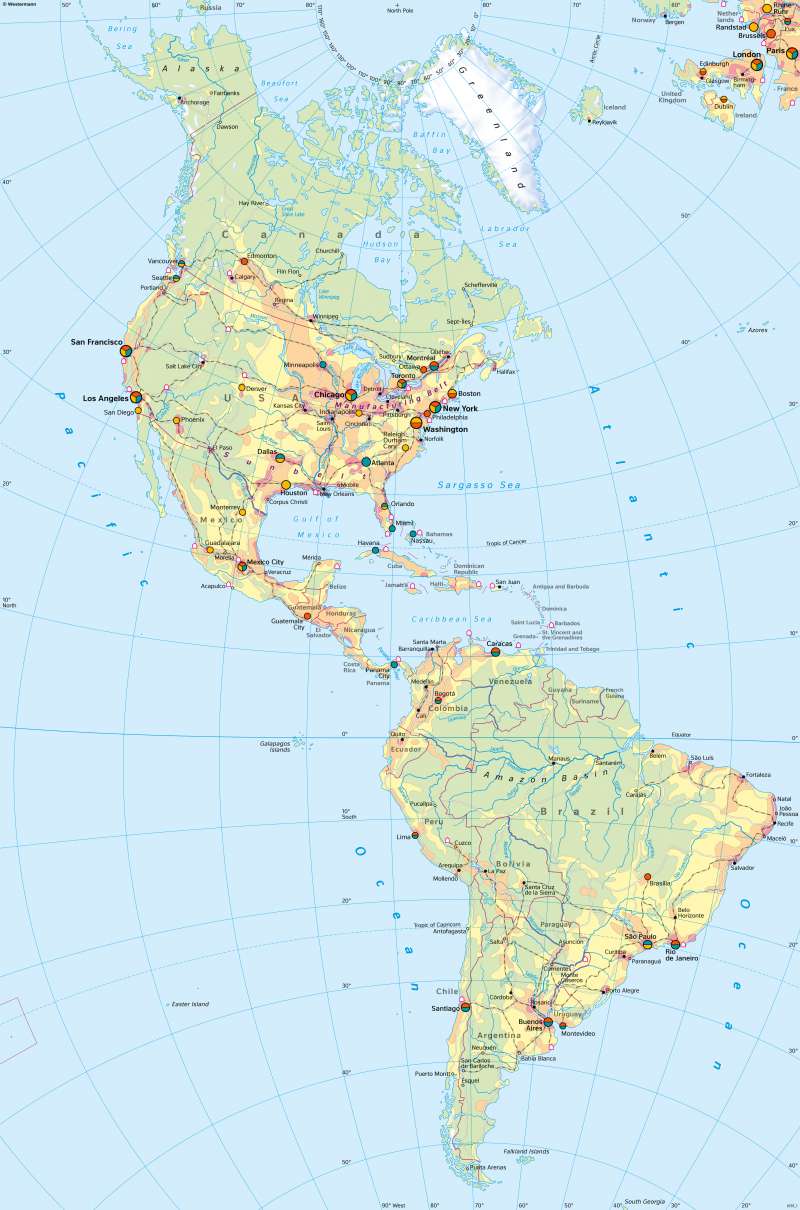
The map clearly shows the dominance of the US economy. The highly dense north-east of the USA with the cosmopolitan cities of New York and Chicago, California with the metropolises of Los Angeles and San Francisco and the north-west as a high-tech centre are the hubs of the global economy. The rise of the USA as an industrial and technological economic power began in the last decades of the 19th century. Even before the outbreak of the First World War, the USA had overtaken Great Britain, the industrial leader at the time. Various factors were decisive for the country's economic success: rich mineral resources, the climatic and scenic diversity, favourable political framework conditions for economic activities, not least the positive attitude towards work, which has its roots in the puritan work ethic of the founding fathers. California's Silicon Valley developed into a world-class centre of innovation.
Huge parts of Canada are very sparsely populated. Almost without exception, the economic centres are located in the south of the country and have de facto grown together with the US ones. A special kind of growth region is currently the Canadian province of Alberta, where the world's second-largest oil reserves lie dormant in huge oil sand deposits. The extremely energy-intensive extraction of these deposits has only become economically profitable due to the sharp rise in world market prices for oil but raises a number of questions with regard to ecological compatibility.
Due to its NAFTA membership, Mexico has a middle position between Anglo- and Latin America. Its national capital is the economic centre of Central America. Many Central American countries, which used to be apostrophised as "banana republics" because of their one-sided dependence on foreign corporations and political interests, have managed to consolidate their states and diversify their economies in recent decades.
South America is characterised by a pronounced coastal orientation. The east coast between Belém on the northern coast of Brazil and Bahia Blanca in Argentina is the most important economic area on the continent. Another economic conurbation around Caracas is largely based on Venezuela's gigantic oil reserves. A band of settlements extends from there along the west coast via Lima to the agglomeration of Santiago. In Amazonia, there is mining, industrial or agricultural use at certain points or in islands. Development takes place along the major rivers or road corridors (Transamazonica).